



Play’n GO is back at it again, dropping Rise of Olympus 1000, the latest entry in their iconic Olympus series. From the original Rise of Olympus that launched back in 2018 to this new version, a lot has changed, and naturally the big question pops up right away — is this upgrade actually good, or did it miss the mark? Players always expect something bigger and better with every new release, and to be fair, Play’n GO definitely understood that pressure this time. They came in swinging with a massive 60,000x max win, which is an absolute banger and instantly gives players something exciting to aim for.
Visually, though, things stay pretty familiar. The graphics haven’t really changed, and honestly, that’s not a bad thing. Longtime fans will be happy to see the same Olympus vibe and the three gods back in action. But here’s where things get interesting — if you’re expecting each god to bring some flashy new power like before, you might be surprised. In this version, they don’t really have their own individual abilities, which makes you pause for a second and wonder… okay, so what’s the real twist this time? That’s where the curiosity kicks in, and now the only thing left to do is dive in and see what kind of chaos Olympus 1000 is actually hiding.
Speaking of changes, Rise of Olympus 1000 switches things up by moving to a scatter-paying system. Wins now land when 8 or more matching symbols show up anywhere on the 6×5 grid, so paylines are officially out of the picture. The three gods still sit at the top as the highest-paying symbols, followed by helms, tridents, and lightning bolts, with the four gems bringing up the rear as the lowest-value symbols.
When it comes to payouts, smaller wins start fairly modest — 8-of-a-kind combinations pay anywhere from 0.1x to 0.8x your stake. One important thing to note is that Rise of Olympus 1000 doesn’t include a wild symbol at all, which keeps the focus fully on clusters and symbol drops rather than traditional slot mechanics.
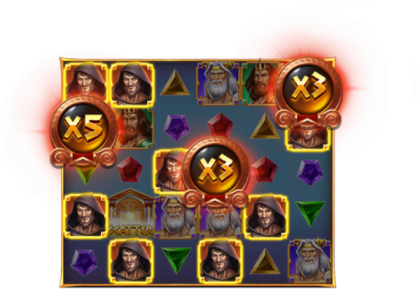
Multipliers are where Rise of Olympus 1000 really starts flexing. The game features 15 multiplier stages, starting from a modest x2 and climbing all the way up to a wild x1,000. These multipliers apply to your total win at the end of the round. If multiple multipliers exists in that case addition of all multipliers will be multiplied to total bet.

When there are no multipliers on the grid, fresh ones can drop in at any time, adding a constant element of surprise. Once a multiplier appears, each cascade gives it a chance to upgrade.

The first upgrade is pretty straightforward, with the multiplier moving up one stage at a time as it builds toward the x1,000 cap, which is the highest it can go. Once it reaches that maximum, it can’t be upgraded any further and simply stays locked on the grid.
After a multiplier has already been upgraded once, things get spicy: future cascades can trigger a super upgrade, which jumps the multiplier forward by several stages at random, sometimes straight toward the top. As long as cascades keep rolling, these super upgrades can happen again and again on multipliers that have already been upgraded — except for the x1,000 multiplier, which is locked in place and can’t go any higher.

The free spins feature kicks off when three or more scatters land in the base game, instantly awarding 12 free spins. During the bonus round, hitting another set of three or more scatters retriggers the feature and adds three extra spins, with the total number of free spins capped at 36.
Throughout the round, multipliers continue to build and stack. Any multiplier that actually plays a role in a winning combination is saved and carried forward all the way to the final free spin. However, multipliers that land or upgrade without contributing to a win are discarded and don’t move forward. All saved multipliers are stored in a multiplier container, and whenever a win hits, the game applies the combined value of all on-screen multipliers plus the container total to the symbol win, making late-round hits especially powerful.

During my 100-spin session, the overall ambience really hit hard and felt very familiar — very much in line with the previous Rise of Olympus titles. I played the entire session at a €1 bet, and while I did pick up a steady stream of small wins, there were no big hits and I didn’t manage to trigger the free spins bonus at all.
That said, the experience didn’t feel dull. What stood out the most was the chase for multipliers, which felt noticeably stronger and more engaging in this version. Even without landing a bonus, the constant anticipation of multipliers dropping and potentially upgrading kept the gameplay tense and exciting. It creates that “one more spin” feeling, where every cascade feels like it could suddenly turn things around, making the base game more entertaining than expected despite the lack of major payouts.
After going through the game properly, you can definitely spot some noticeable changes. The biggest one is the three gods , in this version, they’ve completely lost their individual powers. Instead of god abilities driving the action, the game shifts its focus to multipliers, which pretty much changes the whole feel. So basically, Rise of Olympus 1000 leans more into a scatter-paying setup with heavy multiplier chasing, rather than the god-power moments. Fans might be in hope of god’s power enhancement.
Visually, though, it’s very much business as usual. The look and feel are almost identical to the previous games, so you still get that classic Olympus vibe right away. That familiarity will work for a lot of players, even if nothing feels drastically new on the surface. Some players are probably going to love the constant chase for multipliers, while others might miss the excitement of waiting for a god power to pop and change the game.
Still, one thing that really stands out is the 60,000x max win. That alone is a huge draw and gives the game a clear goal to aim for. Even if the gameplay direction has shifted, that massive win potential is a big part of what makes Rise of Olympus 1000 appealing and keeps players coming back for “just one more spin.”
My name is Manish, and I’ve spent the last 6+ years working at the heart of the iGaming industry, not only as a reviewer, but as a developer building slot clients for some of the industry’s top providers. Read More→