Every slot guide on the internet will tell you that high volatility means big wins but less often, and low volatility means small wins more often. That’s technically true. It’s also completely useless on its own until you don’t understand behind the scene, like how it is configured into the game by using diff weight.
I spent six years building slot games professionally writing front-end clients for some of the industry’s biggest providers. I’ve seen volatility from the inside. Not from a player’s perspective watching the reels spin, but from the code and math models that determine what those reels actually do. That changes how I explain it.
This guide goes beyond the surface definition. By the end you’ll understand what volatility actually is, how it gets built into a game, why two slots with identical RTP can feel completely different, and most importantly, how to use volatility practically before you spend a single dollar.
Volatility, also called variance, is the measure of risk built into a slot’s math model. It describes how a game distributes its returns across spins, not how much it returns overall, but the shape of how those returns arrive.
Think of it like this. Two slots both have 96% RTP. Slot A(ex. starburst is a low volatility game)pays out on roughly 1 in 3 spins with wins mostly between 0.5x and 5x your stake. Slot B(Jelly Express a High Volatility game) pays out on roughly 1 in 8 spins with most wins being small and occasional wins reaching 500x or more. Both return the same 96% over billions of spins. But playing them feels completely different and requires completely different bankroll management.
That difference, the shape of how the money flows is volatility.
It is not the same as RTP. RTP tells you the total amount returned. Volatility tells you how that amount is distributed. A game can have high RTP and high volatility, or low RTP and low volatility, or any combination. They are independent properties.
This is the section you won’t find anywhere else.
When a development team builds a slot, the math team constructs what’s called a pay table model, a complete specification of every symbol, every combination, and every probability. Volatility is not an afterthought. It’s a deliberate design decision made from the start.
Here’s how it works in practice:
Symbol frequency distribution: Each reel position has a weighted probability for each symbol. If the highest-paying symbol appears on reel 1 with a frequency of 1 in 50 positions, it will land far less often than a low-paying symbol appearing 1 in 8. By adjusting these weightings across all reels simultaneously, the math team controls how often full-reel winning combinations form.
Paytable structure: A low volatility slot has a relatively flat paytable, many symbols paying similar amounts, none wildly larger than others. A high volatility slot has a steep paytable, lots of low-paying combinations that happen regularly, and a handful of extremely high-paying combinations that almost never land but account for a large portion of the total theoretical return.
Bonus trigger frequency: Free spins and bonus rounds in high volatility slots are specifically engineered to trigger infrequently typically 1 in 150 to 1 in 300 spins but to return a large multiple of the stake when they do. The bonus round itself is where the bulk of a high volatility slot’s RTP is concentrated. The base game is deliberately lean.
The RTP budget: I always describe RTP as a budget. The math team has a fixed percentage say, 96%, to distribute across all possible outcomes. In a low volatility slot that budget is spread relatively evenly. In a high volatility slot, a significant portion of that budget is allocated to rare, large events, like some specific feature, bonus game etc. The math has to balance, the more budget you allocate to big wins, the less there is for frequent small ones.
Once these parameters are set, the game is simulated billions of times in testing until the theoretical return converges on the target. That’s the certified RTP. The volatility is the shape the math took to get there.
Your game provider will often use four or even five. Here’s the honest breakdown of most commonly used Volatility levels:
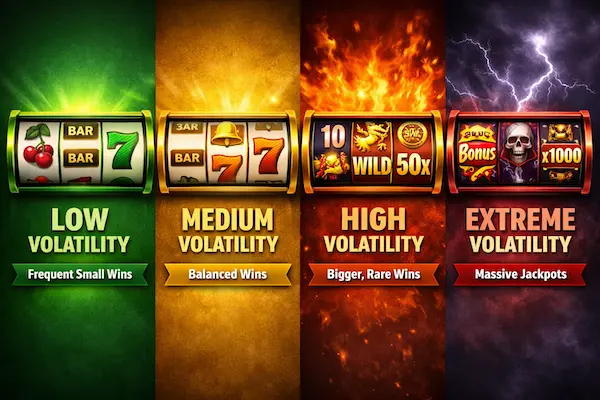
Low Volatility:
Low volatility slots are designed for entertainment value and extended session time. The hit frequency is high often 35% or above, meaning you land some kind of return on more than 1 in 3 spins. Most wins are small, typically between 0.5x and 3x your stake, but they arrive regularly enough to keep your balance stable.
The base game is where most of the action is. Bonus rounds exist but they’re not where the money lives, they just extend the entertainment.
Best for: players with smaller bankrolls, casual sessions, players who want a long game for their money without needing to trigger a bonus.
Real examples: Starburst (NetEnt), Eye of Horus (Blueprint), Book of Dead (Play’n GO).
The honest downside: the ceiling is low. You will rarely if ever see a 500x win from a low volatility slot. The game is engineered not to deliver those moments.
Medium Volatility:
Medium volatility is the most common category in the market because it has the broadest appeal. Hit frequency typically sits between 20% and 30%. Wins arrive often enough to sustain a session but with more variation you’ll have runs where nothing significant happens followed by decent wins that recover the deficit.
The bonus round in a medium volatility slot contributes meaningfully but is not the only place value comes from. You can build a decent session from base game activity alone.
Best for: most players, most session lengths, players who want both entertainment and genuine win potential.
Real examples: Gates of Olympus Super Scatter (Pragmatic Play) at its accessible end, Big Bass Bonanza (Pragmatic Play), Gonzo’s Quest 2(NetEnt).
High Volatility:
High volatility is where most Nolimit City, Hacksaw Gaming, and ELK Studios games live. Hit frequency drops to 15-25%. Dead spin streaks of 20-30 spins without a meaningful win are completely normal and expected, they are the math doing exactly what it was designed to do.
The bulk of the RTP in a high volatility slot is weighted toward the bonus round. The base game exists largely to deliver scatter symbols. When the bonus does trigger, the potential for large multiplied wins justifies everything you went through to get there.
Bankroll requirement increases significantly. Playing a high volatility slot on 20 spins worth of budget is a near-certain loss regardless of RTP. You need enough runway to reach the bonus rounds that carry the real value.
Best for: experienced players, larger bankrolls, players chasing significant wins and prepared for significant dry stretches.
Real examples: Catfish Hunters (Nolimit City), Punk Rocker 3 (Nolimit City), Mental (Nolimit City), Dead or Alive Wanted(NetEnt).
Extreme Volatility:
This is the category most guides don’t cover separately and it’s genuinely different from high volatility.
Extreme volatility slots, Nolimit City uses “10/10” ratings, some providers simply state “extreme”, are engineered for max win potentials of 15,000x to 150,000x or beyond. The math model is structurally different. Dead spin streaks of 50, 80, even 100+ spins with essentially nothing are not unusual. The base game barely functions as a source of value at all, it exists purely to eventually deliver the bonus.
The bonus itself is a multi-stage construction. Think of Nolimit City’s San Quentin 2, the free spins round has its own internal mechanics, multiple levels, and a max win that requires near-impossible alignment of features to reach. Most players will never see anywhere near the ceiling in their lifetime of play.
These games are designed for high-stakes streamers, large bankroll players, and the operator’s high-end revenue segment. For an average player on a standard session budget they are genuinely unsuitable, not because of anything wrong with the game, but because the math model requires an enormous number of spins to even begin exploring its full distribution.
Best for: very large bankrolls only, players who understand they are funding rare astronomical events that may never occur in their specific sessions.
Real examples: San Quentin 2 (Nolimit City), Tombstone Slaughter: El Gordo’s Revenge (Nolimit City), Mental (Nolimit City), Chaos Crew (Hacksaw Gaming).
This is the most important conceptual distinction in slots and the one most players get wrong.
RTP is a fixed mathematical property, you can read more about RTP here. It describes the total percentage returned across all players across all time. It doesn’t change session to session. It doesn’t care if you just won or just lost. A 96% RTP slot will return 96% of everything wagered across billions of spins That’s it.
Volatility describes the shape of how that 96% arrives. Same total return, completely different distribution.
Here’s the practical illustration. Two slots. Both 96% RTP. Slot A is low volatility. In 100 spins at $1 each you spend $100 and get back roughly $92. You win on 38 of those spins. Most wins are between $0.50 and $4. Your balance oscillates steadily. You never feel like you’re losing badly and you never feel like you’re winning dramatically.
Slot B is high volatility. In 100 spins at $1 each you spend $100 and get back roughly $40. You win on 12 of those spins. Most wins are small. But on spin 67 you hit a feature and win $180 in one go. You end the session down $40 despite that one excellent moment.
Both slots are living up to their 96% RTP over billions of spins. Your 100-spin session is a single data point in a distribution of millions. Volatility determines what that data point is likely to look like.
The practical takeaway: choose your volatility level based on your session budget, not on the RTP number. A high volatility 96% RTP slot will drain a small bankroll far faster than a low volatility 94% RTP slot.
There are common five ways to find a slot’s volatility before you play:
1. In-game information panel Every regulated slot has described it under the Game Rules. Many providers now display this explicitly. Nolimit City uses a scale of 1-10. Pragmatic Play labels games as Low, Medium, or High. ELK Studios uses a meter. If you can find it in-game, this is the most reliable source.
2. Provider’s official game page Providers like Nolimit City, Pragmatic Play, Hacksaw Gaming, and BGaming publish volatility information on their official game pages. Check the technical specifications section.
3. Max win as a proxy If the volatility isn’t explicitly stated you can use max win as a strong proxy. Generally:
This isn’t a perfect rule but it’s reliable enough to use as a quick filter.
4. Play the demo first This is what we always do before publishing a review. Play 50-100 spins in demo mode and observe. How often are you winning? How bad are the dry streaks? Does the base game feel active or dead? You can feel volatility in a demo session before you risk real money. We always list Dead Spin Streak in our 100 Spin Experience Result, you can check it and get an idea if the streak is very high then its a Highly Volatile Slot Game.
5. Read reviews that document actual sessions This is exactly why our 100 Spins Experience exists. Every slot review on this site documents a real session win frequency, dead streaks, bonus trigger rate, and overall feel. Use that data before you deposit. We have also described how slots works, you can read it here.
This is the practical section most guides skip entirely.
The size of your session budget should determine your volatility choice, not your personal preference for big wins.
Here’s a simple framework:
If your session budget is 50 spins or fewer at your chosen stake: Play low volatility only. High volatility slots can mathematically run 40+ dead spins in a row. A 50-spin budget on a high volatility game is near-certain bankruptcy before you see meaningful action.
If your session budget is 100-200 spins at your chosen stake: Medium volatility is the appropriate range. You have enough runway to hit at least one bonus trigger and get a meaningful read on the game.
If your session budget is 300+ spins at your chosen stake: High volatility becomes viable. You can survive the inevitable dead stretches and reach the bonus rounds where the real value sits.
If your session budget is 500+ spins: Extreme volatility enters the conversation. Even then, understand that extreme volatility games can run 200+ spins of minimal return. You need to genuinely afford to lose the entire session budget and treat anything that comes back as a bonus.
The number of spins matters more than the total dollar amount. A $100 budget at $0.20 per spin gives you 500 spins viable for high volatility. A $100 budget at $2 per spin gives you 50 spins stick to low or medium volatility at that stake.
At WinningSpinSlots every review includes a documented 100 Spins Experience, a real session at a fixed stake tracking win frequency, dead streaks, bonus triggers, and overall feel. This data reveals volatility in practice more honestly than any paytable description.
Here’s what we’ve observed across volatility categories in our sessions:
Low Volatility:
Wins: 35-40
Dead Streak: 3-5
Bonus Round: 1-2
Session Feel: Steady, Relaxed
Medium Volatility:
Wins: 20-30
Dead Streak: 5-12
Bonus Round: 0-1
Session Feel: Mixed, Engaging
High Volatility:
Wins: 10-20
Dead Streak: 15-30
Bonus Round: 0-1
Session Feel: Tense, Engaging
Extreme Volatility:
Wins: 5-10
Dead Streak: 30-60
Bonus Round: 0(often)
Session Feel: Brutal, Engaging
These are approximate ranges based on documented sessions, not mathematical guarantees. Your session will vary, this is the nature of variance. But these ranges give you a realistic expectation before you play.
Volatility in slots, also called variance, is the measure of risk built into a game’s math model. It describes how a slot distributes its returns across spins. Low volatility means frequent small wins. High volatility means infrequent but larger wins. Both can have identical RTP, volatility describes the shape of how the returns arrive, not the total amount returned.
RTP is the total percentage returned to players over billions of spins, it tells you how much the game pays back overall. Volatility describes how that return is distributed whether it arrives as many small wins or rare large ones. Two slots can have identical 96% RTP but completely different volatility. They return the same total amount but feel entirely different to play.
Extreme volatility is a step beyond high volatility, typically rated 9-10/10 by providers like Nolimit City. These games have very low hit frequencies, long dead spin streaks, and max win potentials of 15,000x to 150,000x or more. The base game barely functions as a source of value almost everything is concentrated in the bonus round. Extreme volatility slots require large bankrolls and genuine comfort with long losing sessions.
As a general rule you need at least 100-200 spins worth of budget to get meaningful value from a high volatility slot. For extreme volatility, 300-500 spins minimum. If your budget only covers 30-50 spins, stick to low or medium volatility, high volatility dead streaks can mathematically exceed your entire bankroll before the first bonus triggers.
No. Volatility is engineered into the game’s math model by the developer and certified by independent testing labs before release. A casino cannot alter the volatility. However casinos can choose which RTP variant of a game to run this doesn’t change the volatility structure but does affect how the base game feels in short sessions.
Neither is objectively better, they serve different playing styles and bankroll sizes. High volatility gives you the chance at large wins but requires patience, a bigger budget, and tolerance for long dry spells. Low volatility gives you more consistent entertainment and longer session time for the same budget. The right choice depends entirely on how you want to play, not on which one pays more.
My name is Manish, and I’ve spent the last 6+ years working at the heart of the iGaming industry, not only as a reviewer, but as a developer building slot clients for some of the industry’s top providers. Read More→